Daily Calorie Calculator: How to Calculate Your Calorie Needs
Knowing your daily calorie needs is the foundation of any nutrition plan. Without this number, you are guessing — and guessing leads to frustration. Whether you want to lose weight, build muscle, or simply eat better, a daily calorie calculator gives you the starting point you need. In this guide, we explain exactly how to calculate your daily calorie needs using the same method our free calorie intake calculator uses behind the scenes.
If you have ever wondered how many calories should I eat a day, the answer starts with understanding two key numbers: your BMR and your TDEE. Once you understand these, everything else falls into place.
What Is a Daily Calorie Calculator?
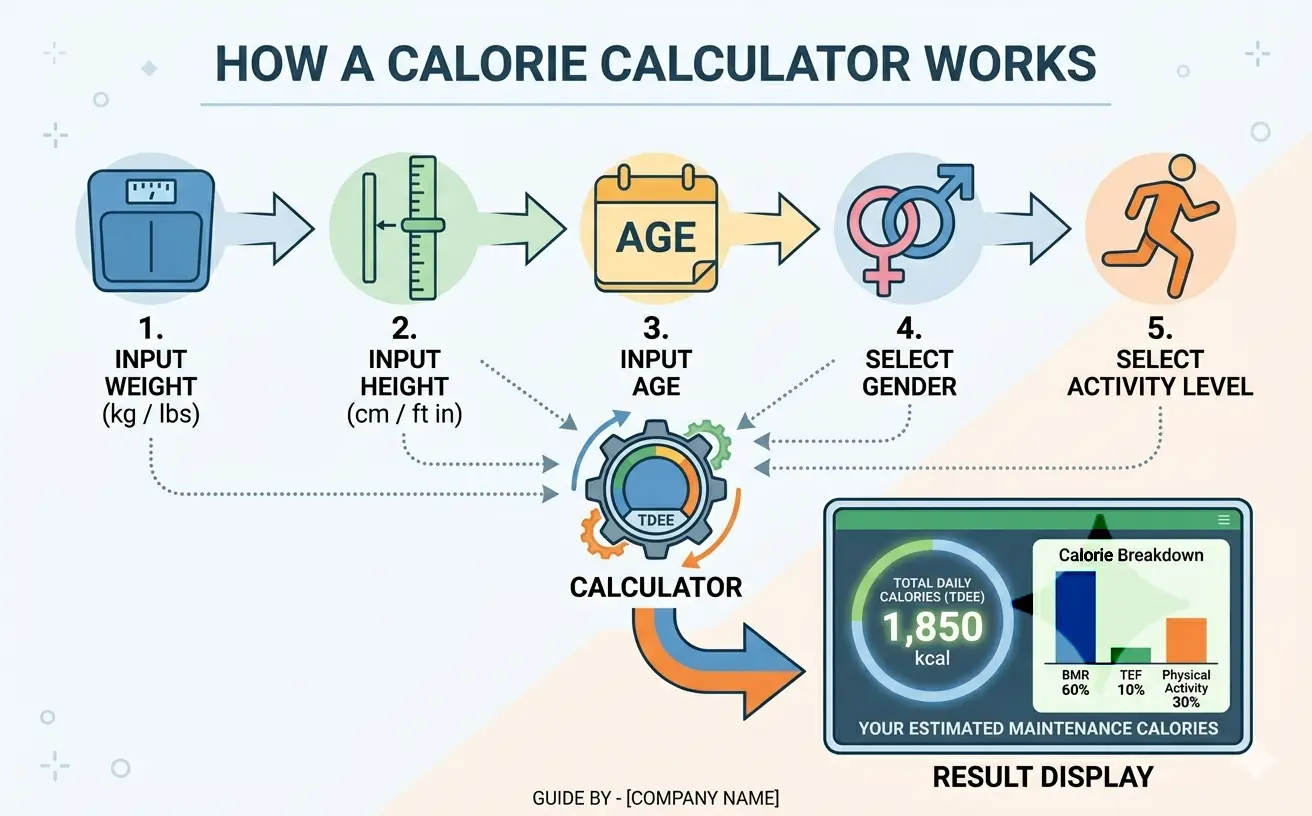
A daily calorie calculator is a tool that estimates how many calories your body burns in a 24-hour period. It takes your personal details — age, weight, height, gender, and activity level — and runs them through a scientific formula to give you a personalized number. This number represents your maintenance calories: the amount you need to eat to stay at your current weight.
From there, you can adjust up or down depending on your goal. Eat less than your maintenance number, and you lose weight. Eat more, and you gain weight. It sounds simple, and it is — as long as you have an accurate starting point. That is exactly what our calorie intake calculator provides.
BMR vs TDEE: The Two Numbers That Matter
To understand how a daily calorie calculator works, you need to know the difference between BMR and TDEE. These two terms come up constantly in nutrition, and they are often confused.
Basal Metabolic Rate (BMR)
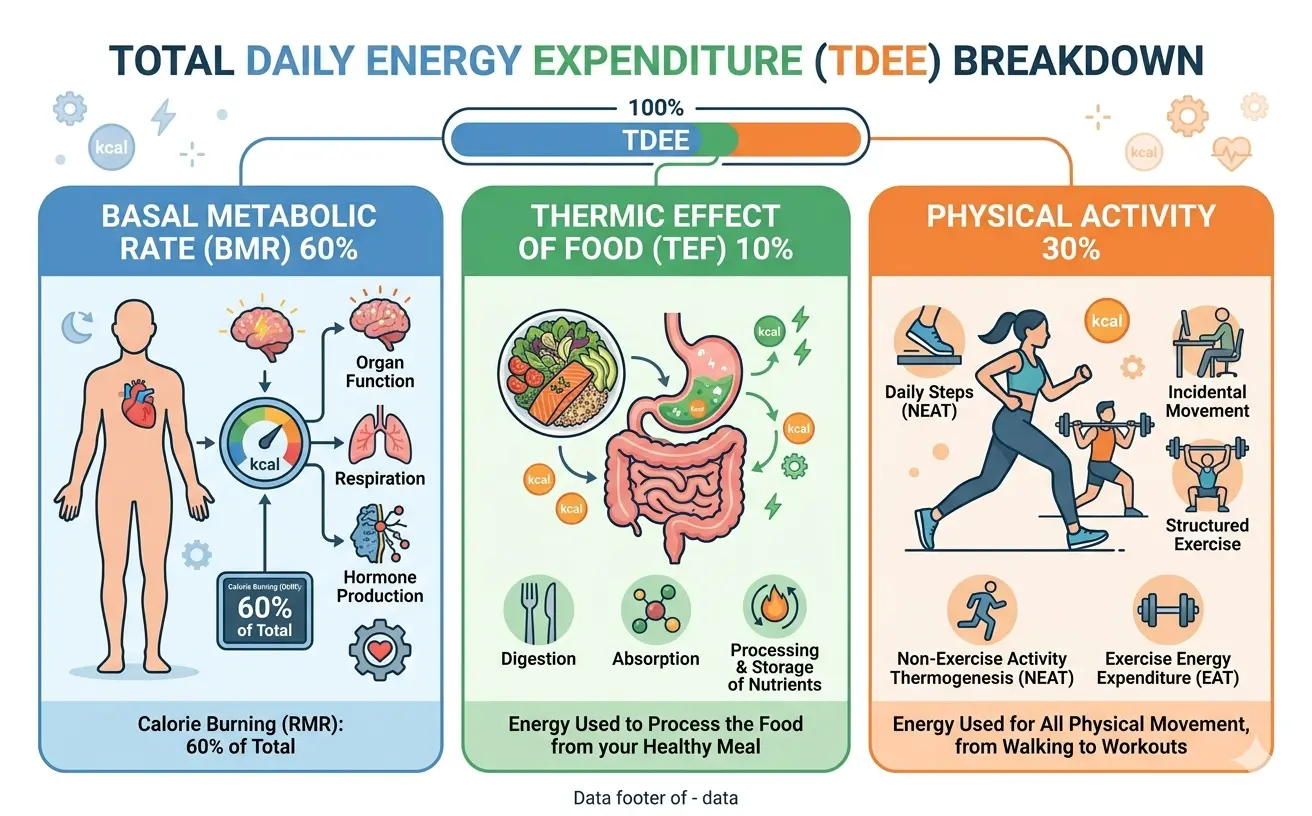
Your BMR is the number of calories your body burns at complete rest. Think of it as the energy cost of keeping you alive — your heart pumping, your lungs breathing, your brain thinking, your cells repairing. BMR accounts for roughly 60 to 70 percent of your total daily calorie burn.
BMR is determined mostly by your body size and composition. Taller people and people with more muscle mass have higher BMRs. Age also plays a role — BMR naturally declines about 1 to 2 percent per decade after age 20, which is one reason many people gain weight as they get older even if their diet does not change.
Total Daily Energy Expenditure (TDEE)
Your TDEE is your BMR plus all the calories you burn through activity and digestion. It includes:
- BMR: 60-70% of total burn.
- Thermic Effect of Food (TEF): About 10% — the energy needed to digest and process what you eat.
- Physical Activity: 20-30% — everything from planned workouts to walking, fidgeting, and doing chores.
Your TDEE is the number you actually need to pay attention to. It represents your true daily calorie burn. If you want a deeper dive into how activity levels affect this number, read our guide on TDEE activity multipliers to understand each level in detail.
How the Mifflin-St Jeor Equation Works
The most accurate daily calorie calculators use the Mifflin-St Jeor equation to estimate BMR. Developed in 1990 and validated across large, diverse populations, it is now considered the gold standard — more reliable than the older Harris-Benedict equation from 1919.
Here is what the formulas look like:
- For Men: BMR = (10 × weight in kg) + (6.25 × height in cm) − (5 × age) + 5
- For Women: BMR = (10 × weight in kg) + (6.25 × height in cm) − (5 × age) − 161
Once your BMR is calculated, it gets multiplied by an activity factor to produce your TDEE. The activity factors range from 1.2 for sedentary individuals to 1.9 for extremely active people like professional athletes. If you are curious about why Mifflin-St Jeor replaced Harris-Benedict, we have a full breakdown of the Mifflin-St Jeor equation and the research behind it.
How to Calculate Your Daily Calorie Needs Step by Step
You do not need to do math manually — our calorie intake calculator handles everything instantly. But understanding the steps helps you trust the result. Here is the process:
- Calculate your BMR using the Mifflin-St Jeor formula based on your weight, height, age, and gender.
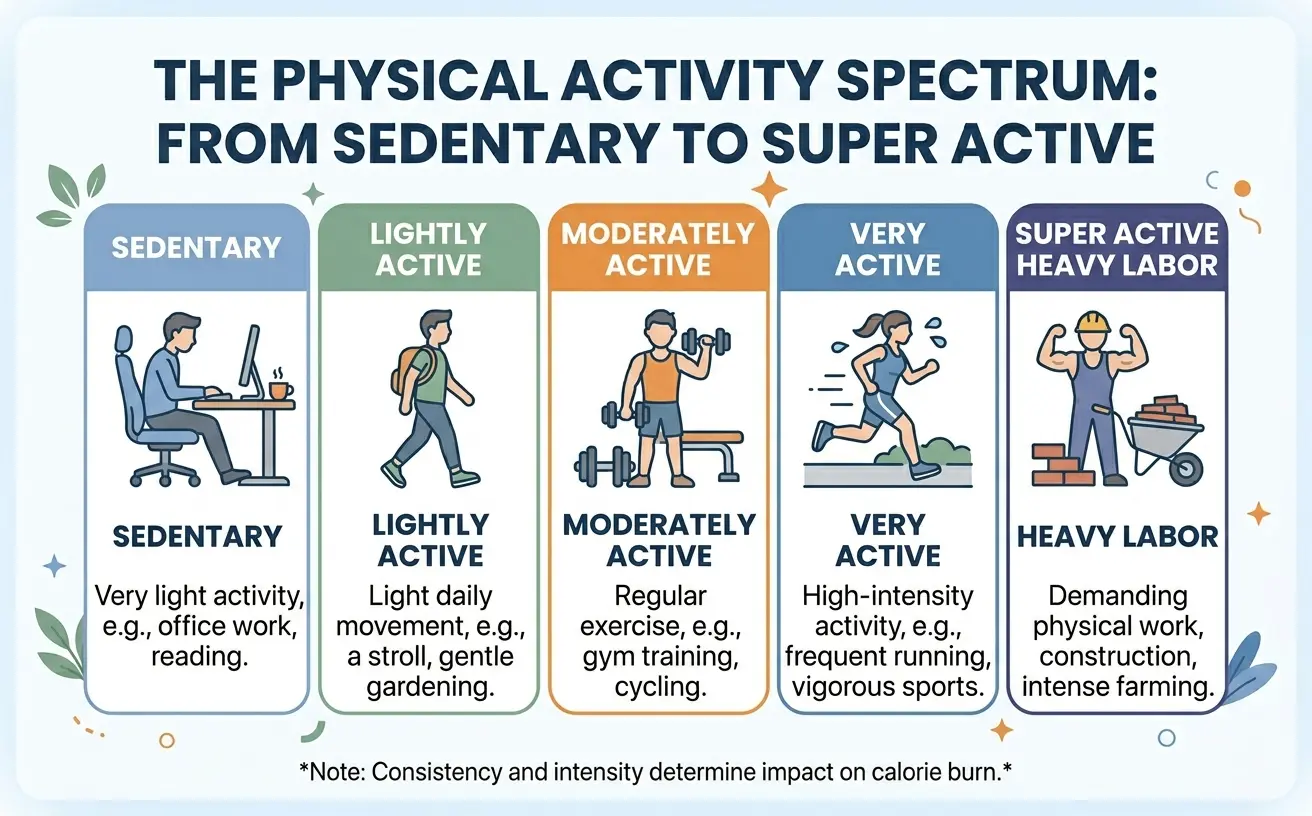
- Select your activity level from the dropdown menu options, ranging from Sedentary to Super Active. Read each description carefully and choose honestly — most people overestimate how active they really are.
- Multiply BMR by activity factor to get your TDEE — your estimated daily calorie burn.
- Adjust for your goal: Subtract 500 calories for weight loss, add 300-500 for muscle gain, or stay at maintenance.
For example, a 35-year-old man weighing 80 kg, standing 178 cm tall, with a moderately active lifestyle would have a TDEE of approximately 2,600 calories per day. That is his maintenance number — the target he needs to hit to stay at his current weight.
How to Use Your Calorie Target for Weight Loss
Once you have your maintenance number from the daily calorie calculator, creating a calorie deficit is straightforward. A deficit of 500 calories per day leads to about one pound of fat loss per week. This pace is safe, sustainable, and recommended by most health organizations.
Here is what this looks like:
- Maintenance TDEE: 2,500 calories
- Weight loss target: 2,000 calories per day
- Weekly deficit: 3,500 calories (one pound of fat)
However, there is a floor you should not go below. Most experts recommend at least 1,200 calories per day for women and 1,500 for men. Eating too little can slow your metabolism, cause muscle loss, and lead to nutrient deficiencies. For a complete guide on setting the right deficit, read our article on safe calorie deficit for men and women.
If you want a tool specifically designed for weight loss planning, check out our dedicated calorie calculator for weight loss guide that walks you through setting up your deficit step by step.
How to Use Your Calorie Target for Muscle Gain
Building muscle requires a calorie surplus — you need to eat more than you burn. For most people, a surplus of 300 to 500 calories per day provides enough extra energy for muscle growth without excessive fat gain.
Protein intake matters here too. While your calorie surplus provides the energy, protein provides the building blocks. If you are serious about gaining muscle, use our daily protein intake calculator to make sure you are getting enough. And for a complete bulking strategy, check out our guide on how to calculate calorie intake for muscle gain.
Common Mistakes When Using a Daily Calorie Calculator
Even with an accurate calculator, people make errors that throw off their results. Here are the most common ones to avoid:
- Overestimating activity level: If you sit at a desk all day and exercise three times a week, you are moderately active at most — not very active. When in doubt, pick the lower level.
- Using the wrong units: Our calculator uses metric units (kilograms and centimeters). If you only know your weight in pounds, simply divide by 2.2 to get kilograms. For height, multiply inches by 2.54 to get centimeters. Double-check your conversions before entering your numbers.
- Not recalculating: As you lose or gain weight, your calorie needs change. Recalculate every 10 to 15 pounds of weight change.
- Forgetting non-exercise activity: Walking, cleaning, shopping, and playing with kids all burn calories. Someone who averages 10,000 steps per day but never formally works out may still be lightly or moderately active.
- Eating back all exercise calories: Fitness trackers often overestimate calorie burn from workouts. If weight loss is your goal, eat back only about half of estimated exercise calories.
How Other Health Metrics Fit Into the Picture
Your daily calorie target is just one piece of the health puzzle. For a complete picture of your nutritional status, consider these related measurements:
- BMI: Your Body Mass Index tells you whether your weight is in a healthy range for your height. Use our free BMI calculator to check yours.
- Hydration: Proper water intake supports metabolism, digestion, and energy levels. Try our water intake calculator to find your daily hydration target.
- Exercise Intensity: Knowing your target heart rate zones helps you train more effectively. Our target heart rate calculator can help.
Putting It All Together: Your Daily Action Plan
Here is a simple plan to start using your daily calorie target today:
- Calculate: Use our free calorie intake calculator to find your maintenance calories. This takes 30 seconds.
- Set your goal: Subtract 500 for weight loss, add 300-500 for muscle gain, or stay at maintenance. Write your target down.
- Track for a week: Use a food diary or app to see how close you come to your target. Do not aim for perfection — consistency is what matters.
- Check results: Weigh yourself once a week, same day, same time. After two to three weeks, adjust by 100-200 calories if the scale is not moving.
- Recalculate: Come back to the calculator every four to six weeks as your weight and activity levels change.
Related Guides: Dive Deeper Into Calorie Counting
Want to learn more? Explore our complete library of calorie and nutrition guides:
- Calorie Calculator for Weight Loss — Set up your calorie deficit the right way for sustainable results.
- How Many Calories to Lose Weight: A Complete Guide — Safe deficit strategies for men and women.
- Mifflin-St Jeor Equation Explained — The science behind the formula and why it replaced Harris-Benedict.
- Activity Level Multipliers Explained — How to choose the right TDEE factor for accurate results.
Frequently Asked Questions
How do I know if my daily calorie target is accurate?
The Mifflin-St Jeor equation is accurate within about 10% for most healthy adults. Treat your result as a starting point, then adjust based on real-world results. If you are eating at your calculated maintenance level and your weight is stable, the number is correct. If your weight is changing, adjust by 100-200 calories and reassess after two weeks.
Should I use a daily calorie calculator if I am pregnant?
Standard calorie calculators are not designed for pregnancy or breastfeeding, which increase calorie needs significantly — typically by 300 to 500 calories per day. Always consult your healthcare provider for personalized nutrition guidance during pregnancy.
How often should I recalculate my calorie needs?
Recalculate every 10 to 15 pounds of weight change, or every four to six weeks if you are actively losing or gaining weight. Your BMR changes as your body composition changes, so a number that worked two months ago may not be accurate today.
Why do men and women have different calorie formulas?
Men and women have different Mifflin-St Jeor equations because of differences in average body composition. Men typically carry more muscle mass, which burns more calories at rest. The formulas reflect these physiological differences to produce more accurate estimates for each gender.
Can I use the daily calorie calculator for my teenager?
Our calculator is designed for adults aged 18 and older. Teenagers have additional caloric needs due to growth and development that standard adult formulas do not account for. If you are under 18, consult a doctor or registered dietitian for guidance.

Start Calculating Your Daily Calorie Needs Now
You now understand what BMR and TDEE mean, how the Mifflin-St Jeor equation works, and how to use your calorie target for weight loss or muscle gain. The next step is simple: get your personalized number.
Take 30 seconds and use our free daily calorie calculator now. No sign-up, no cost, instant results. It is the first step toward a smarter, more informed approach to your nutrition.
For a complete picture of your health, also explore our related calculators:
- BMI Calculator — Check if you are in a healthy weight range.
- Daily Protein Intake Calculator — Find out how much protein you need.
- Water Intake Calculator — Calculate your daily hydration needs.