
Activity Level Multipliers Explained: Choosing the Right TDEE Factor
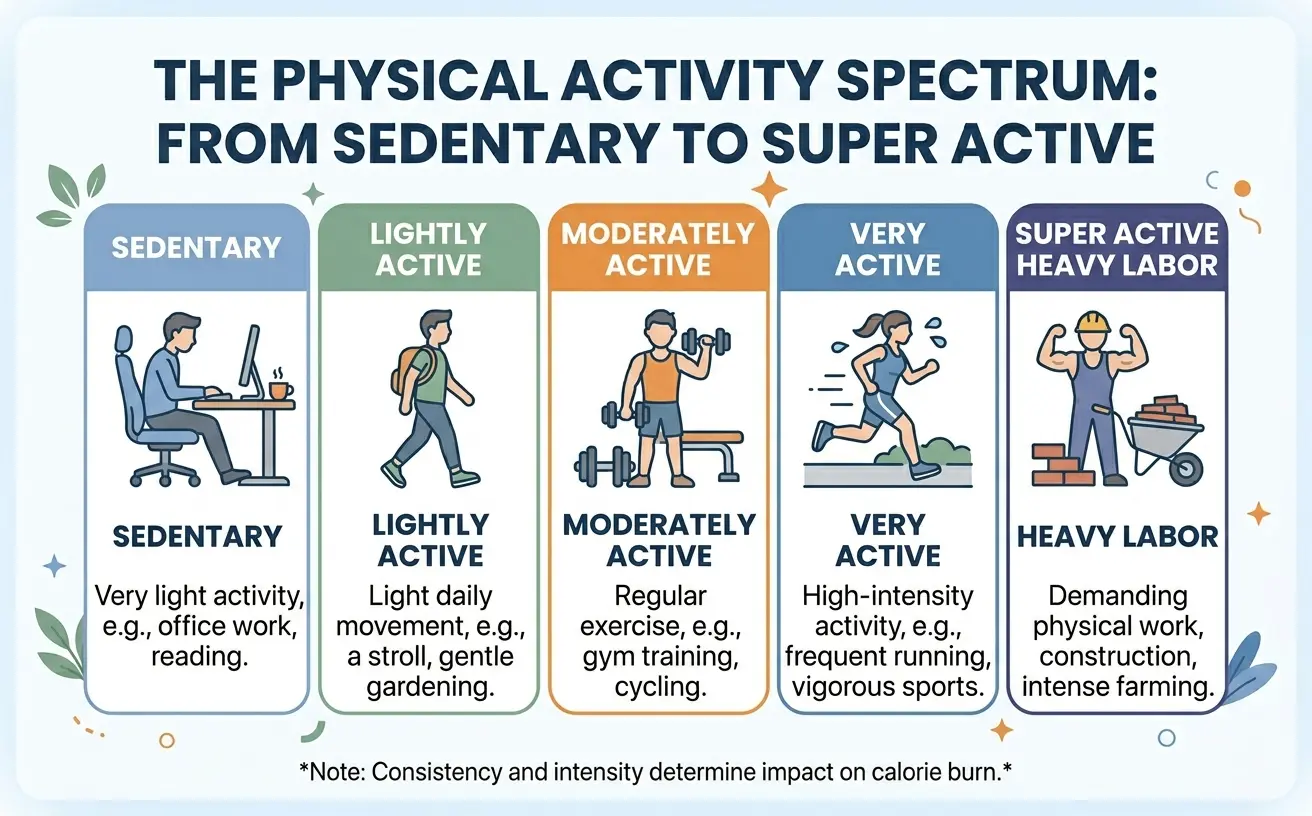
You have entered your weight, your height, your age, and your gender into a calorie calculator. Then you reach the activity level dropdown and hesitate. Are you sedentary or lightly active? What is the difference between moderately active and very active? If you pick the wrong one, your entire calorie target could be off by hundreds of calories per day.
This is not a small decision. Your activity level multiplier is the number that transforms your BMR into your TDEE — your total daily calorie burn. Choose too low, and you may undereat and lose energy. Choose too high, and you may wonder why you are not losing weight despite eating your calculated target. In this guide, we explain exactly what each activity level means with concrete, real-world examples so you never have to guess again. To put this into practice, use our free calorie intake calculator and select your activity level with confidence.
What Are Activity Level Multipliers?
Activity level multipliers, also called TDEE factors, are the numbers used to convert your Basal Metabolic Rate into your Total Daily Energy Expenditure. Your BMR is what your body burns at complete rest. But nobody stays at complete rest all day. You walk, you work, you exercise, you fidget. The activity multiplier accounts for all of that additional movement.
Here are the five standard multipliers used in most calorie calculators, including ours:
| Activity Level | TDEE Multiplier | Exercise Frequency |
|---|---|---|
| Sedentary | BMR × 1.2 | Little to no structured exercise |
| Lightly Active | BMR × 1.375 | Light exercise 1–3 days/week |
| Moderately Active | BMR × 1.55 | Moderate exercise 3–5 days/week |
| Very Active | BMR × 1.725 | Hard exercise 6–7 days/week |
| Super Active | BMR × 1.9 | Physical job + intense daily training |
The difference between choosing Sedentary and Moderately Active for someone with a BMR of 1,500 calories is 525 calories per day. That is the difference between losing a pound a week and maintaining your weight. Choosing correctly matters. To understand how BMR is calculated before the multiplier is applied, read our guide on the Mifflin-St Jeor equation that powers the calculator.
Sedentary (BMR × 1.2): Little or No Exercise
This is the baseline activity level for someone whose daily life involves mostly sitting with very little structured exercise.
You are sedentary if:
- You have a desk job and sit for most of your working hours.
- You do not engage in any planned exercise or sports.
- You average fewer than 5,000 steps per day.
- Your primary leisure activities are screen-based, like watching TV or gaming.
- You drive or take public transport for most trips, with minimal walking.
Real-world example: A remote software developer who works from a home office, drives to run errands, and spends evenings watching Netflix. They might walk to the kitchen and back a few times and take out the trash, but they do not have a workout routine.
Common mistake: People who go to the gym twice a week for 30 minutes sometimes still select Sedentary because they feel they are not "real" exercisers. But if you are doing structured workouts even twice a week, you are at least Lightly Active.
Lightly Active (BMR × 1.375): Light Exercise 1-3 Days Per Week
This is the most commonly underestimated category. Many people who are lightly active incorrectly select Sedentary because they compare themselves to fitness influencers who train six days a week.
You are lightly active if:
- You do light exercise like walking, gentle yoga, or recreational cycling one to three days per week.
- You average 5,000 to 7,500 steps per day.
- You have a desk job but take short walks during breaks or stand for portions of the day.
- You do household chores like cleaning, gardening, or playing with kids on weekends.
Real-world example: A teacher who stands and walks around the classroom during the day, takes a 20-minute walk after dinner three times a week, and does yard work on Saturdays.
Common mistake: Assuming that because your workouts are not intense, they do not count. Light activity is still activity. If you walk consistently, you are not sedentary.

Moderately Active (BMR × 1.55): Moderate Exercise 3-5 Days Per Week
This is where most active adults fall. If you exercise regularly but do not live in the gym, this is likely your category.
You are moderately active if:
- You exercise three to five days per week with moderate intensity — activities like running, swimming, weight training, group fitness classes, or competitive sports.
- You average 7,500 to 10,000 steps per day.
- Your workouts last 30 to 60 minutes and elevate your heart rate.
- You have a job that involves some movement, like retail, nursing, or working with children.
Real-world example: An office worker who goes to the gym for 45 minutes of weight training on Monday, Wednesday, and Friday, plays basketball with friends on Saturday, and averages 8,000 steps per day from daily walking.
Common mistake: Selecting Moderately Active when you exercise once or twice a week. Moderate means consistent, not occasional. Three sessions per week is the minimum threshold for this level.
Very Active (BMR × 1.725): Hard Exercise 6-7 Days Per Week
This category is for people with demanding training schedules or physically active jobs combined with exercise.
You are very active if:
- You train hard six to seven days per week, often with multiple sessions per day.
- You are training for a marathon, triathlon, or competitive sport.
- You average more than 12,000 steps per day.
- You have a physically demanding job — like construction, landscaping, or warehouse work — and you also exercise regularly.
Real-world example: A construction worker who is on his feet lifting and moving materials for eight hours a day and also does CrossFit four evenings per week.
Common mistake: Overestimating into this category because you feel tired after workouts. Training hard is not the same as training often. Very Active requires both frequency and intensity across most days of the week.
Super Active (BMR × 1.9): Physical Job Plus Intense Training
This is the highest activity level and applies to a very small percentage of the population. It is reserved for elite athletes and people with extremely demanding physical lifestyles.
You are super active if:
- You have a physically exhausting job and you train intensely on top of it.
- You are a professional or collegiate athlete in season.
- You train multiple hours per day, most days of the week.
- Your daily step count consistently exceeds 15,000, and much of that is at high intensity.
Real-world example: A professional firefighter who does heavy resistance training five days per week and plays a sport competitively on weekends.
Common mistake: Almost everyone who selects this category should actually be in Very Active. Unless you are paid to be physically active or training at an elite competitive level, this category is not for you.
How to Choose the Right Activity Level: A Simple Decision Guide
If you are still unsure, answer these three questions honestly:
- How many days per week do you do structured exercise? If zero, you are Sedentary. If one to three, Lightly Active. If three to five, Moderately Active. If six to seven, Very Active.
- What is your average daily step count? Check your phone or fitness tracker. Under 5,000 is Sedentary. Five thousand to 7,500 is Lightly Active. Seven thousand five hundred to 10,000 is Moderately Active. Over 12,000 is Very Active.
- What is your job? Desk job moves you down one category. Job with significant standing and walking keeps you at your exercise-based level. Physically demanding job moves you up one category.
When in doubt, choose the lower activity level. It is far better to slightly underestimate your calorie burn and adjust upward if needed than to overestimate and wonder why your results are not matching your expectations. For the full picture on how this multiplier fits into your daily calorie calculation, read our guide on how to calculate your daily calorie needs.
The Most Common Activity Level Mistakes
After analyzing how thousands of people use calorie calculators, here are the most frequent errors and how to avoid them:
- Selecting Moderately Active when you are Sedentary: You work a desk job, do not exercise, and walk 4,000 steps per day. But you selected Moderately Active because you feel busy and run errands on weekends. Busyness is not the same as physical activity.
- Selecting Sedentary when you are Lightly Active: You walk 7,000 steps per day and do yoga twice a week, but you selected Sedentary because you do not "work out hard." Light activity counts. Do not sell yourself short.
- Overestimating because of one intense workout: You crushed a two-hour gym session on Saturday, but sat at your desk and did nothing else all week. That one workout does not make you moderately active. Look at your entire week, not your best day.
- Ignoring non-exercise activity: Your steps taken while shopping, cleaning, playing with kids, and walking to your car all count toward your activity level. Someone who averages 10,000 steps daily without formal workouts may still be lightly or moderately active.
Frequently Asked Questions
What if I exercise 3 days a week but have a desk job?
You are likely Moderately Active if those three workouts are of moderate to high intensity and last 30 to 60 minutes each. The desk job does not cancel out the exercise. However, if your three workouts are light 20-minute walks, you are Lightly Active.
Does walking count as exercise for activity level?
Yes. Walking is legitimate physical activity. If you walk briskly for 30 to 60 minutes most days and average over 7,500 steps, you are at least Lightly Active. If you walk 10,000 or more steps daily, you may be Moderately Active even without formal gym workouts.
How do I know if I should move up an activity level?
Move up if you have been consistently eating at your calculated maintenance calories for two to three weeks and are losing weight unintentionally. Your body is telling you that you are burning more than the calculator estimated, which means your activity level selection was too low.
What activity level should I choose if I am just starting to exercise?
Choose based on your current activity, not your planned activity. If you are currently sedentary but plan to start exercising three times a week, select Sedentary for now. Recalculate after you have been consistent with your new routine for at least three to four weeks.
Can my activity level change from week to week?
Yes. Some weeks are busier or more active than others. However, your TDEE calculation should be based on your typical week, not your best week or your worst week. Look at your average over the past month to make an accurate selection.
Related Guides: Master Your Calorie Calculations
Understanding activity levels is just one piece of the puzzle. Complete your knowledge with these resources:
- Mifflin-St Jeor Equation Explained — The formula that calculates your BMR before the multiplier is applied.
- Calories Per Day to Lose Weight: Safe Deficit Guide — Recommended calorie ranges by age and gender for weight loss.
- How Many Calories Should I Eat a Day? — The complete beginner's guide to understanding your daily calorie needs.
- Calorie Calculator for Weight Loss — Apply your TDEE to losing fat.
Get Your Accurate TDEE Now
You now know exactly what each activity level means and how to choose the right one. No more guessing. No more second-guessing the dropdown menu. Use our free calorie intake calculator, select your activity level with confidence, and get a TDEE you can trust. No sign-up, no cost, instant results.