Calorie Calculator for Weight Loss: How Many Calories to Lose Weight

Weight loss can feel complicated. There are countless diets, meal plans, and conflicting advice competing for your attention. But at its core, losing weight comes down to one simple principle: you need to burn more calories than you consume. A calorie calculator for weight loss takes the guesswork out of this equation by telling you exactly how many calories to eat each day to shed pounds safely.
Our free calorie intake calculator does the math for you in seconds. Enter your details, get your maintenance calories, subtract your deficit, and you have a personalized weight loss target. In this guide, we will walk you through exactly how to use it, what deficit to aim for, and the most common mistakes to avoid.
How a Calorie Calculator for Weight Loss Works
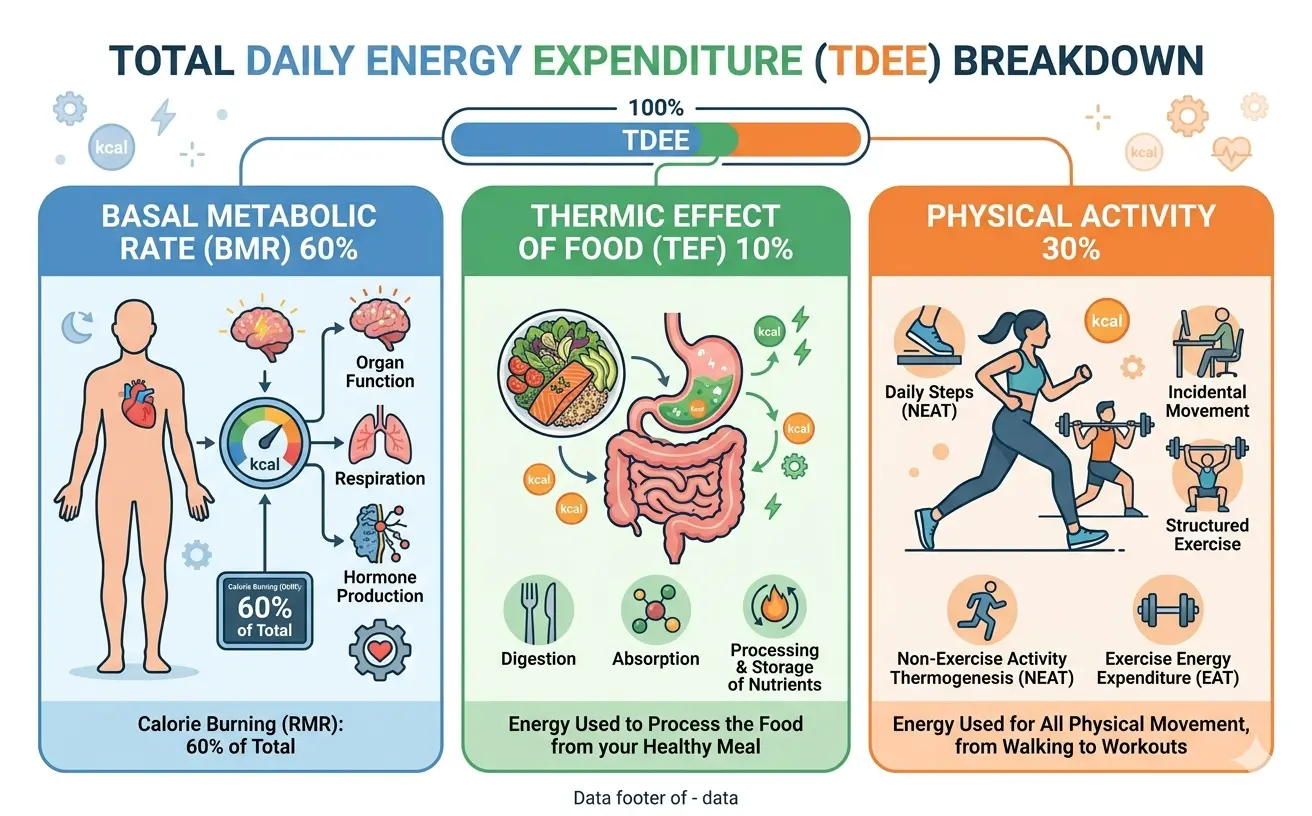
A calorie calculator for weight loss works in two steps. First, it estimates your maintenance calories — the number of calories your body burns each day based on your age, weight, height, gender, and activity level. This is your TDEE, or Total Daily Energy Expenditure. Second, you create a calorie deficit by eating fewer calories than your maintenance number. That deficit forces your body to tap into stored fat for energy, and you lose weight.
The math behind the calculator uses the Mifflin-St Jeor equation, the most accurate BMR formula available for the general population. If you want the full breakdown of how that formula works, read our guide on the Mifflin-St Jeor equation and why it replaced the older Harris-Benedict model.
How Many Calories Should I Eat to Lose Weight?
This is the question everyone starts with, and the answer depends on your maintenance TDEE. The standard recommendation is a daily deficit of 500 calories below your maintenance level. Since one pound of body fat contains roughly 3,500 calories, a 500-calorie daily deficit adds up to 3,500 calories per week — or about one pound of fat loss.
Here is a real example using our calculator:
- Person: 35-year-old woman, 75 kg, 165 cm tall, lightly active.
- Maintenance TDEE: approximately 2,000 calories per day.
- Weight loss target: 1,500 calories per day.
- Expected result: about one pound of weight loss per week.
This pace is safe, sustainable, and recommended by most health organizations including the CDC and NHS. Faster weight loss is possible with a larger deficit, but it is harder to maintain and increases the risk of muscle loss and nutrient deficiencies.
What Is a Safe Calorie Deficit?
Not all deficits are created equal. Here is a breakdown of what different deficit levels mean for your body:
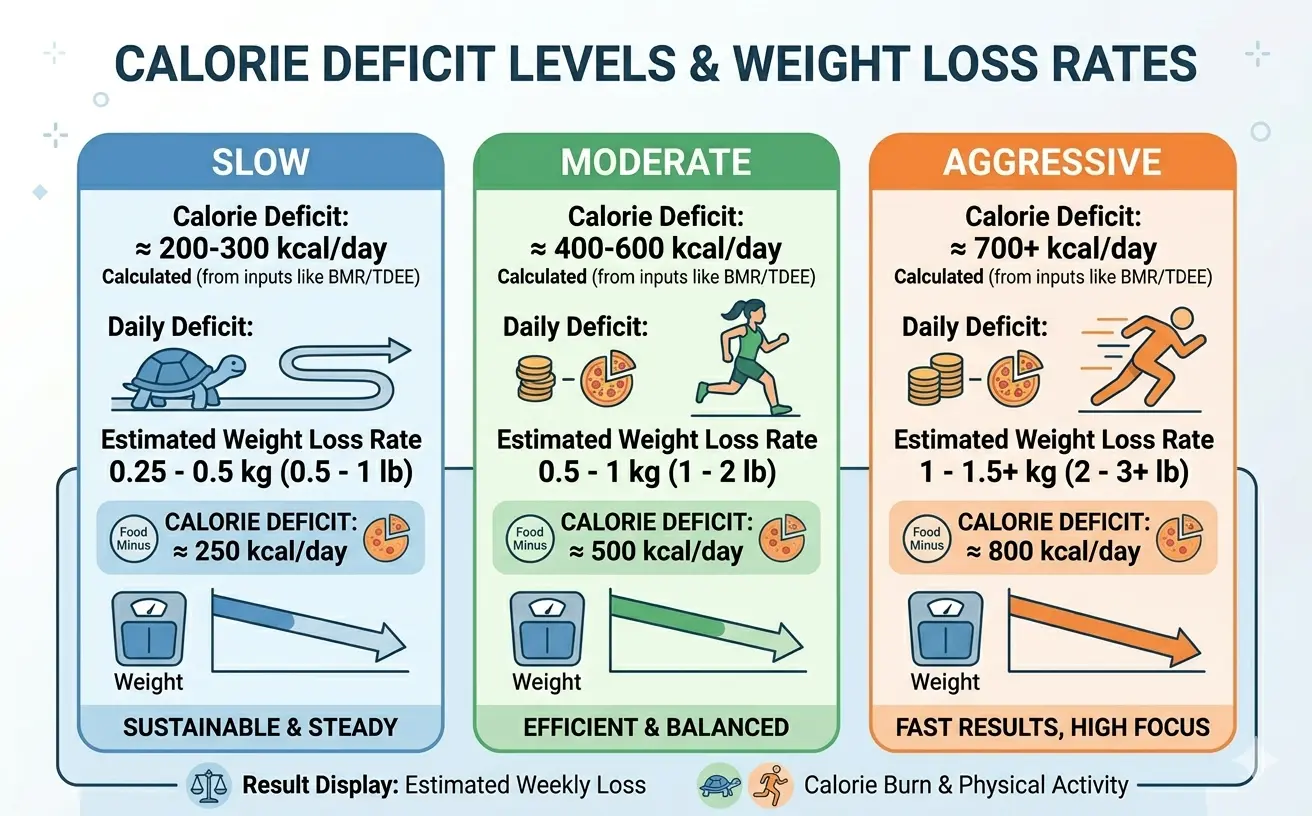
- 250-calorie deficit: Slow, steady weight loss of about half a pound per week. Ideal if you are close to your goal weight or want to preserve maximum muscle mass.
- 500-calorie deficit: The sweet spot for most people. One pound per week. Sustainable, manageable hunger levels, and minimal muscle loss when combined with adequate protein.
- 750-1,000 calorie deficit: Aggressive weight loss of 1.5 to 2 pounds per week. Only recommended for people with significant weight to lose and under medical supervision.
⚠️ Critical Safety Thresholds
Most medical professionals agree that your daily intake should never drop below these baseline limits without direct clinical supervision:
- Women: Minimum of 1,200 calories per day.
- Men: Minimum of 1,500 calories per day.
Going below these baselines risks triggering a severe metabolic slowdown, nutritional deficiencies, and muscle tissue wasting.
For a detailed breakdown of these safety limits by age and gender, see our guide on safe calorie deficit for men and women.
How to Set Up Your Weight Loss Calorie Target Step by Step
Follow these steps to use the calorie calculator for weight loss effectively:
- Enter your details: Input your weight in kilograms, height in centimeters, age, and gender into the calculator. If you know pounds, divide by 2.2 to get kilograms. For inches, multiply by 2.54 to get centimeters.
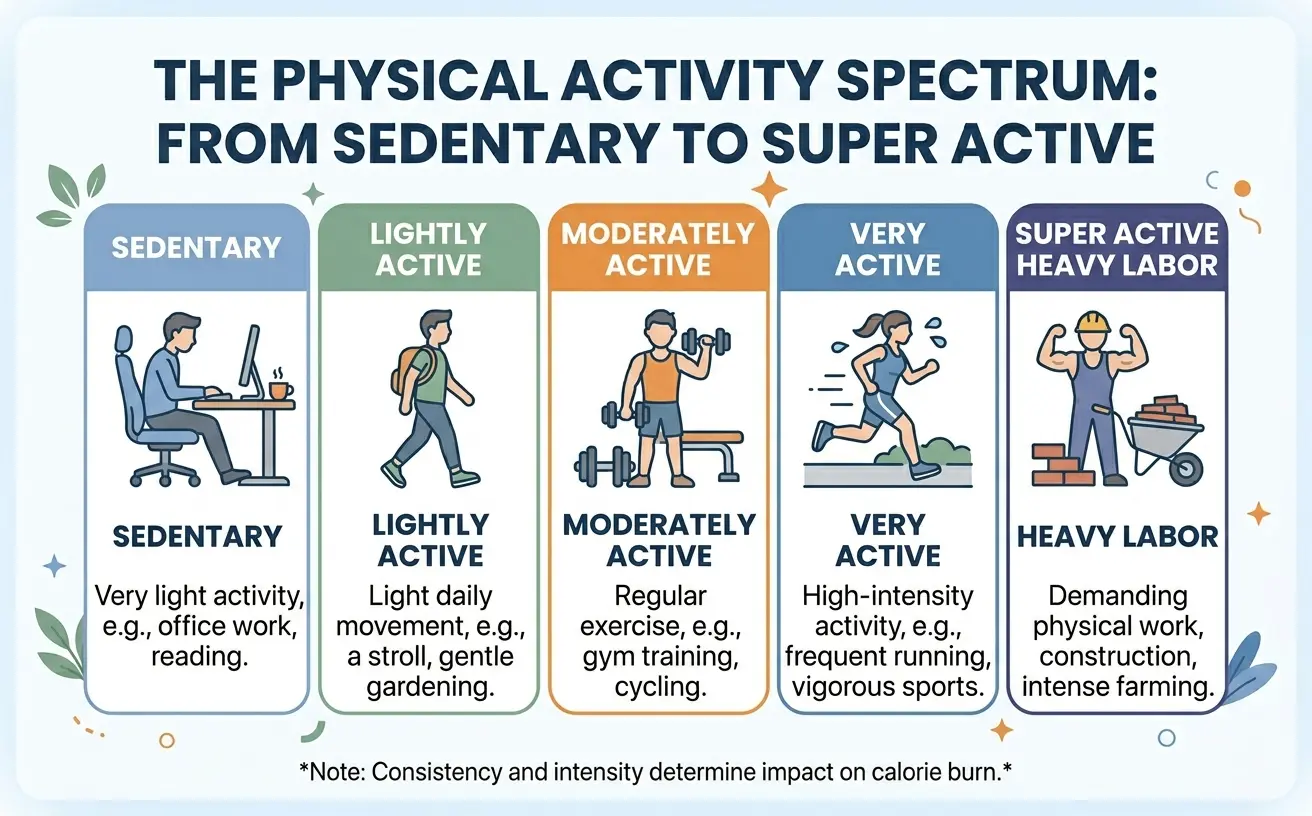
- Choose your activity level: Select from the dropdown menu, which ranges from Sedentary (little or no exercise) to Super Active (physical job plus intense training). Be honest — most people overestimate this.
- Get your maintenance calories: The calculator instantly shows your TDEE. This is how many calories you burn per day at your current weight and activity level.
- Subtract your deficit: For most people, subtract 500 calories from your maintenance number. This gives you your daily weight loss calorie target.
- Track and adjust: Follow your target for two to three weeks. Weigh yourself once a week under the same conditions. If the scale is not moving, reduce by another 100-200 calories. If you are losing more than 2 pounds per week, increase slightly to protect your muscle mass.
Why Your Calorie Deficit Might Not Be Working
You have calculated your deficit. You are tracking your food. But the scale is not moving. Here are the most common reasons why, and how to fix them:
- You overestimated your activity level: If you chose Moderately Active but sit at a desk for eight hours and only hit the gym twice a week, your actual TDEE is lower. Drop your activity level down one tier and recalculate.
- You are not tracking everything: Cooking oils, coffee creamer, sauces, and bites of your kid's leftovers all count. These hidden calories can wipe out a 500-calorie deficit in a single day. Weigh and log everything for at least one week to see where calories sneak in.
- You are eating back all your exercise calories: Fitness trackers and gym machines routinely overestimate calorie burn by 20-30%. If you add 400 calories to your daily budget because the treadmill says you burned 400, you might be eating back your entire deficit.
- Your body is retaining water: New exercise routines, high-sodium meals, hormonal fluctuations, and lack of sleep can all cause temporary water retention that masks fat loss on the scale. Stay consistent and look for trends over weeks, not days.
- You need to recalculate: If you have already lost 10-15 pounds, your smaller body now burns fewer calories. Return to the calculator and get an updated target.
Should You Combine Calorie Counting with Exercise?
You can lose weight through diet alone, but combining a calorie deficit with exercise delivers better results. Here is why:
- Preserves muscle mass: Strength training signals your body to hold onto muscle while burning fat. Without it, some of your weight loss will come from muscle, not just fat.
- Increases your TDEE: More activity means a higher maintenance calorie number, which means you can eat more while still losing weight.
- Improves body composition: Two people can weigh the same but look completely different depending on their muscle-to-fat ratio. Exercise shapes your body as you shrink it.
For a complete fitness picture, pair our calorie calculator with our free BMI calculator to track changes in your weight category, and use our target heart rate calculator to make sure your workouts are intense enough to make a difference.
How to Stay Full on Fewer Calories
One of the biggest challenges of a calorie deficit is hunger. Here are evidence-based strategies to stay satisfied while eating less:
- Prioritize protein: Protein is the most satiating macronutrient. Aim for 25-30 grams per meal from sources like chicken, fish, eggs, Greek yogurt, or legumes. Use our daily protein intake calculator to find your target.
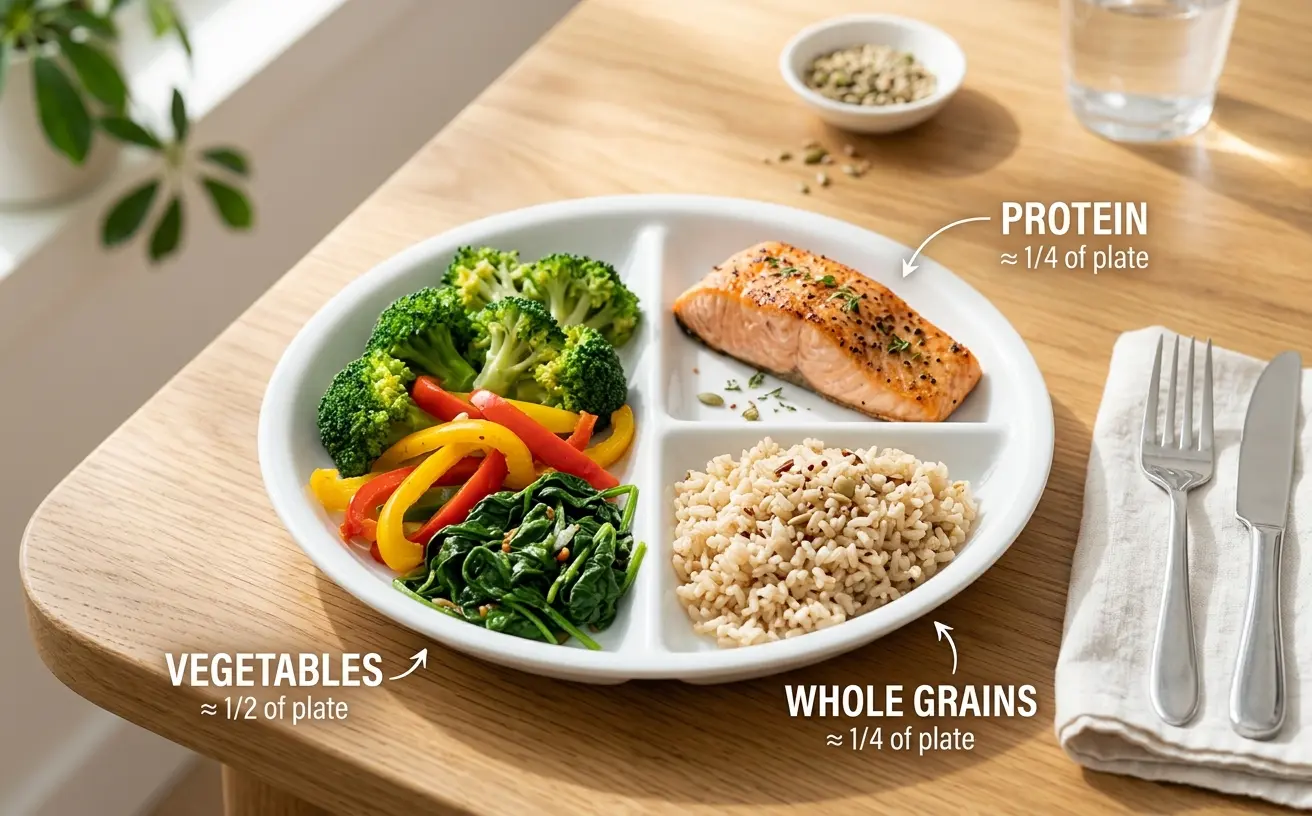
- Fill up on fiber: Vegetables, fruits, whole grains, and legumes add bulk to your meals without adding many calories. A plate half-filled with vegetables is a simple visual rule.
- Drink enough water: Thirst is often mistaken for hunger. Try our water intake calculator to find your daily hydration target.
- Eat slowly: It takes about 20 minutes for your brain to register fullness. Slowing down gives your body time to send the signal before you overeat.
- Get enough sleep: Sleep deprivation increases ghrelin, the hunger hormone, and decreases leptin, the fullness hormone. Aim for 7-9 hours per night.
How Long Will It Take to Reach Your Goal Weight?
With a consistent 500-calorie daily deficit, you can expect to lose about one pound per week. Here is what that looks like over time:
- 5 pounds: About 5 weeks
- 10 pounds: About 10 weeks
- 20 pounds: About 20 weeks (5 months)
- 50 pounds: About 50 weeks (just under a year)
These are estimates. Weight loss is rarely perfectly linear. You might lose 3 pounds one week and zero the next. Plateaus happen. The key is consistency over months, not perfection every single day. If you want a complete step-by-step weight loss roadmap, read our guide on how many calories to lose weight safely for more detailed strategies.
Frequently Asked Questions
Can I lose weight without counting calories?
Yes, but it is harder to be precise. Strategies like portion control, mindful eating, and cutting out processed foods can create a calorie deficit without tracking every number. However, if you are not seeing results after a few weeks, tracking calories for even a short period can help you understand where excess calories are coming from.
How fast can I lose weight safely?
One to two pounds per week is considered safe and sustainable by most health organizations. Losing weight faster than this increases the risk of muscle loss, gallstones, nutrient deficiencies, and metabolic slowdown. Very low-calorie diets should only be done under medical supervision.
Do I need to eat less on rest days?
Your maintenance calorie calculation already averages your activity across the entire week, including rest days. You do not need to eat dramatically less on days you do not work out. However, some people prefer a slight reduction of 100-200 calories on rest days, which is fine as long as your weekly average stays on target.
What if I am not losing weight even at 1,200 calories per day?
If you are consistently eating 1,200 calories and not losing weight, one of several things is likely happening: you may be underestimating portions, your activity level may be lower than you think, you may have a medical condition affecting metabolism, or your body may have adapted to a prolonged low-calorie intake. Consult a doctor or registered dietitian for personalized advice in this situation.
Can I use the calorie calculator if I have a medical condition?
Our calorie calculator provides general estimates for healthy adults. If you have a medical condition such as diabetes, thyroid disease, PCOS, or a history of eating disorders, your calorie needs may differ significantly from standard formulas. Always consult your healthcare provider before starting a weight loss plan.
Related Guides: Build Your Complete Weight Loss Plan
Combine this guide with our other resources to create a comprehensive weight loss strategy:
- How Many Calories Should I Eat a Day? — The foundational guide to understanding your daily calorie needs.
- Daily Calorie Calculator: How to Calculate Your Calorie Needs — A step-by-step walkthrough of BMR and TDEE.
- Calories Per Day to Lose Weight: Safe Deficit Guide — Recommended calorie ranges by age and gender.
- How to Calculate Calorie Intake for Muscle Gain — Flip the equation and build muscle instead.
Start Your Weight Loss Journey Today
Weight loss does not require a complicated diet, expensive supplements, or hours of daily exercise. It requires a consistent calorie deficit, and that starts with knowing your numbers. Use our free calorie intake calculator now. Enter your details, get your personalized weight loss target in seconds, and take the first real step toward your goal. No sign-up required. Instant results.