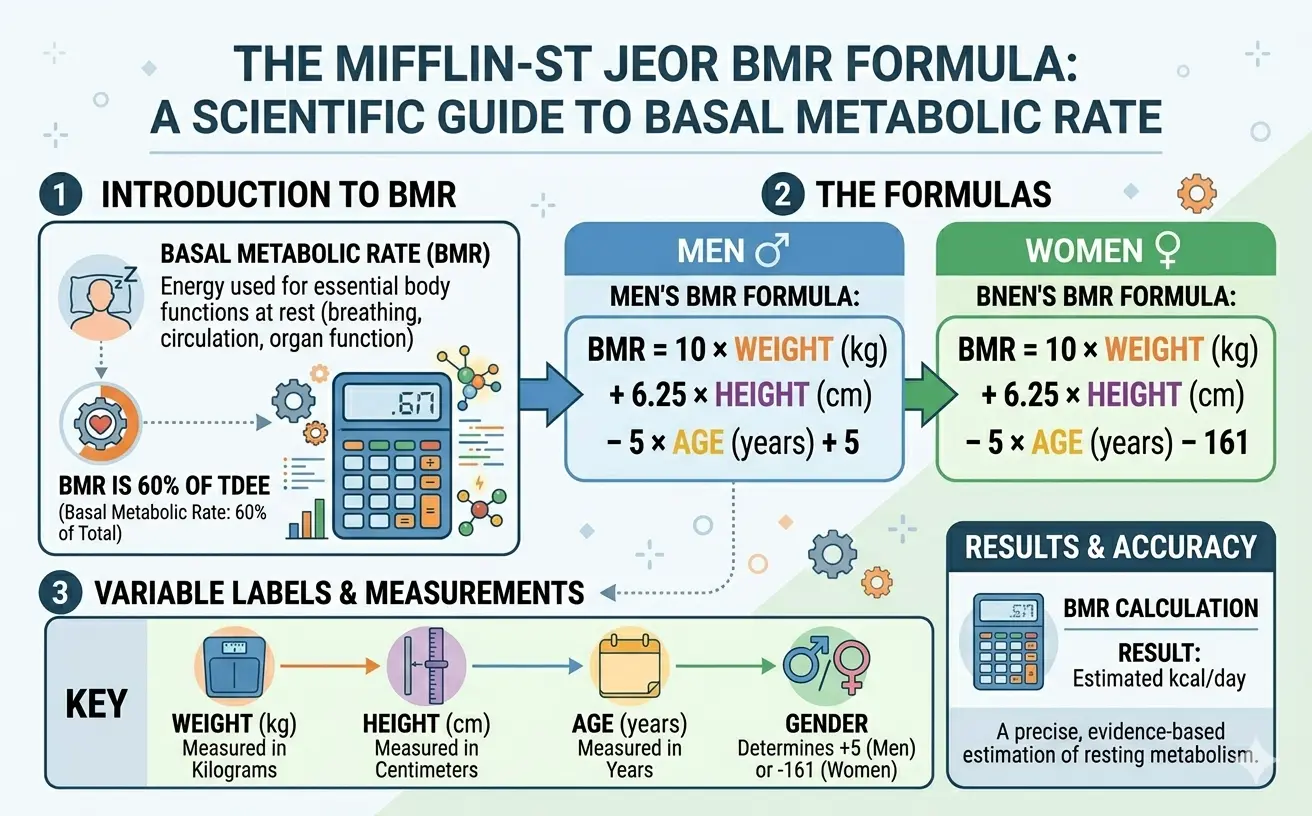
How Many Calories Should I Eat to Lose Weight? A Complete Guide

If you have ever typed "how many calories should I eat to lose weight" into a search bar, you already know the frustration. Some sources say 1,200. Others say 1,800. A few tell you to cut 500 calories from somewhere, but they never explain where to start. The truth is that your ideal calorie target for weight loss depends entirely on your body, your activity level, and your goals. There is no single magic number that works for everyone.
In this guide, we cover exactly how to find your personal weight loss calorie target, what minimums you should never cross, and how to adjust as your body changes. To get your personalized number right now, use our free calorie intake calculator — it takes 30 seconds and does all the math for you.
How Many Calories Should I Eat to Lose Weight? The Short Answer
For most adults, a daily intake of 500 calories below your maintenance level produces about one pound of fat loss per week. Your maintenance level is your Total Daily Energy Expenditure, or TDEE — the number of calories your body burns each day based on your age, weight, height, gender, and activity level.
Here is what that looks like for a typical person:
A 40-year-old woman weighing 80 kg, standing 165 cm tall, with a lightly active lifestyle has a TDEE of approximately 2,020 calories.
- Her weight loss target: 1,520 calories per day.
- Expected result: about one pound of weight loss per week.
That is the basic formula. But the real question is not just how many calories — it is how low is too low, and how to make those calories count nutritionally. The rest of this guide answers both.
How to Find Your Personal Weight Loss Calorie Target
Follow these five steps to calculate your personal number:
- Calculate your maintenance calories: Enter your weight in kilograms, height in centimeters, age, and gender into a calorie calculator. If you know pounds, divide by 2.2 to get kilograms. For inches, multiply by 2.54 to get centimeters.
- Choose your activity level: Select from the dropdown menu, which ranges from Sedentary (little or no exercise) to Super Active (physical job plus intense training). Most people overestimate this, so when in doubt, pick the lower option.
- Get your TDEE: The calculator shows your maintenance number. This is how many calories you burn per day right now.
- Subtract 500 calories: This creates your daily weight loss target. For faster results, you can subtract up to 750, but do not drop below the safety minimums in the next section.
- Recalculate every 10-15 pounds: As you lose weight, your body burns fewer calories. Return to the calculator regularly to update your target.
Minimum Calorie Limits: How Low Is Too Low?
Calorie deficits work, but they have a floor. Eating too little backfires. Here are the minimum daily intake levels that most health organizations recommend:
⚠️ Critical Safety Thresholds
Most medical professionals agree that your daily intake should never drop below these baseline limits without direct clinical supervision:
- Women: Minimum of 1,200 calories per day.
- Men: Minimum of 1,500 calories per day.
Going below these baselines risks triggering a severe metabolic slowdown, nutritional deficiencies, and muscle tissue wasting.
For a more detailed breakdown of how these limits vary by age and body type, read our guide on safe calorie deficit for men and women.
Calorie Targets by Gender and Age
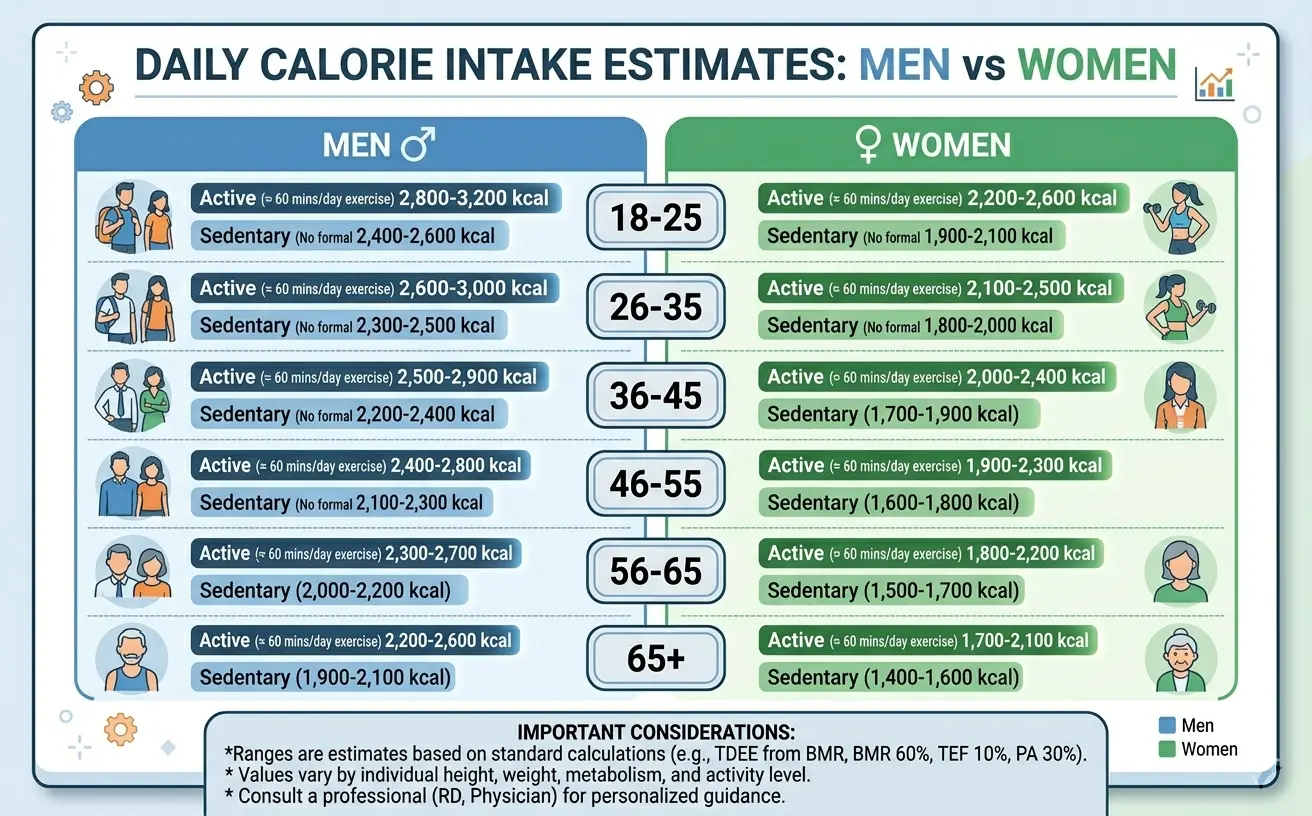
While everyone needs a personalized calculation, here are general ranges to give you a starting point. These numbers assume a moderate deficit for steady weight loss:
Women: Estimated Weight Loss Calorie Ranges
- Age 18-25: 1,500 – 1,800 calories per day
- Age 26-35: 1,400 – 1,700 calories per day
- Age 36-45: 1,300 – 1,600 calories per day
- Age 46-55: 1,200 – 1,500 calories per day
- Age 56+: 1,200 – 1,400 calories per day
Men: Estimated Weight Loss Calorie Ranges
- Age 18-25: 2,000 – 2,400 calories per day
- Age 26-35: 1,900 – 2,300 calories per day
- Age 36-45: 1,800 – 2,200 calories per day
- Age 46-55: 1,700 – 2,000 calories per day
- Age 56+: 1,600 – 1,900 calories per day
These are estimates based on average heights and moderate activity levels. Your actual number may be higher or lower. The only way to know for sure is to use a calculator that factors in your specific details. If you want to understand the formula behind these numbers, read our guide on how the Mifflin-St Jeor equation calculates your BMR.
How to Adjust Your Calories as You Lose Weight
Your calorie target is not set in stone. As your body changes, your needs change too. Here is how to adjust over time:
- Every 10-15 pounds lost: Recalculate your TDEE. A 200-pound body burns more calories than a 170-pound body doing the same activities.
- If weight loss stalls for 3+ weeks: You may have hit a plateau. Reduce your daily intake by 100-200 calories and reassess after two weeks.
- If you increase your activity: If you go from walking twice a week to running four times a week, your activity level has changed. Update it in the calculator and get a new target.
- If you feel constantly hungry or tired: Your deficit may be too aggressive. Increase your daily intake by 100-200 calories. Slower weight loss that you can sustain is better than fast weight loss you cannot maintain.
- If you start strength training: Muscle tissue burns more calories at rest than fat tissue. Over time, your metabolism may increase slightly, and you may need to adjust your intake upward to avoid losing weight too quickly.
What About Very Low-Calorie Diets?
You may have heard of very low-calorie diets, or VLCDs, that prescribe 800 calories or fewer per day. These diets do produce rapid weight loss, but they come with serious risks:
- Muscle loss: When calories drop too low, your body breaks down muscle tissue for energy, not just fat.
- Metabolic slowdown: Your body adapts to starvation by burning fewer calories, making future weight loss harder.
- Nutrient deficiencies: It is nearly impossible to meet your vitamin and mineral needs on fewer than 1,200 calories without medical supplementation.
- Gallstones: Rapid weight loss increases the risk of developing gallstones.
VLCDs should only be attempted under direct medical supervision, typically for people with obesity-related health conditions where the benefits of rapid weight loss outweigh the risks. For the vast majority of people, a moderate deficit of 500 calories per day is safer and more sustainable.
How to Make Your Calories Count
When you are eating fewer calories, every bite matters. Here is how to get the most nutrition out of your daily allowance:
- Prioritize protein at every meal: Protein preserves muscle mass during weight loss and keeps you full longer. Aim for 25-30 grams per meal. Use our daily protein intake calculator to find your personal target.
- Fill half your plate with vegetables: Vegetables provide volume, fiber, vitamins, and minerals for very few calories. They are the most efficient way to feel full on a deficit.
- Do not drink your calories: Sugary drinks, fruit juices, and alcohol add hundreds of calories without filling you up. Water, black coffee, and unsweetened tea are your best options. Try our water intake calculator to find your daily hydration target.
- Include healthy fats: A small amount of fat from sources like olive oil, avocado, nuts, and seeds helps your body absorb fat-soluble vitamins and keeps you satisfied.
- Plan your meals: People who plan their meals in advance tend to make better food choices and stick to their calorie targets more consistently than those who decide what to eat in the moment.
Should You Track Calories Forever?
Calorie tracking is a tool, not a lifestyle. Here is a realistic progression:
- First 2-4 weeks: Track everything. Weigh your food. Learn what portions actually look like. Most people are surprised by how quickly calories add up from oils, sauces, and snacks.
- Next 2-3 months: Track most days, but give yourself breaks on weekends or special occasions. You should start to develop an intuition for portion sizes and calorie content.
- Long-term maintenance: Once you reach your goal weight, you may not need to track daily at all. Many people shift to checking in periodically, such as tracking for one week every month to make sure their habits have not drifted.
The goal is to build lasting habits, not to log every calorie for the rest of your life. For the full picture on how to set up your daily calorie target, read our guide on how to calculate your daily calorie needs.
Frequently Asked Questions
Why am I not losing weight even though I am eating fewer calories?
This is one of the most common frustrations. The most likely culprits are: underestimating portion sizes, forgetting to track cooking oils and condiments, overestimating your activity level, or retaining water due to new exercise, high sodium intake, or hormonal changes. Track every single thing that passes your lips for one week, weigh yourself under identical conditions, and if the scale still does not move after three weeks, reduce your intake by 100-200 calories.
Can I lose weight without counting calories?
Yes. Strategies like intermittent fasting, reducing processed foods, eating more protein and vegetables, and practicing mindful eating can all create a calorie deficit without explicit tracking. However, if you try these methods for a month and see no results, calorie counting for a short period can help you understand where hidden calories are coming from.
How many calories should a woman eat to lose weight?
Most women lose weight on 1,200 to 1,700 calories per day, depending on age, weight, height, and activity level. The exact number varies significantly. A 25-year-old active woman might lose weight at 1,800 calories, while a 55-year-old sedentary woman might need 1,300. Always use a calculator with your personal details rather than relying on a one-size-fits-all number.
How many calories should a man eat to lose weight?
Most men lose weight on 1,500 to 2,300 calories per day, depending on age, weight, height, and activity level. Taller men and men with physically demanding jobs will be at the higher end. Shorter men with desk jobs will be at the lower end. A personalized calculation is essential.
Is it better to eat fewer calories or exercise more?
Both work, but diet has a bigger impact on weight loss than exercise. It is much easier to create a 500-calorie deficit by eating less than it is to burn 500 calories through exercise. A 500-calorie workout might take an hour of intense running. Cutting 500 calories from your diet might mean skipping one sugary coffee drink and a bag of chips. The most effective approach combines a moderate calorie deficit from diet with regular exercise for overall health and muscle preservation.
Related Guides: Complete Your Weight Loss Knowledge
Combine this guide with our other in-depth resources:
- How Many Calories Should I Eat a Day? — The complete beginner's guide to understanding your daily calorie needs.
- Calorie Calculator for Weight Loss — Set up your personalized deficit step by step.
- How to Calculate Calorie Intake for Muscle Gain — Flip the equation and build muscle with the right surplus.
- Activity Level Multipliers Explained — How to choose the right TDEE factor for accurate results.
Get Your Personal Weight Loss Calorie Target Now
You have read the ranges, the safety limits, and the strategies. Now it is time to get your number. Use our free calorie intake calculator to find your maintenance calories and your personalized weight loss target in seconds. No sign-up, no cost, instant results. It is the most important first step you can take today.