Mifflin-St Jeor Equation: How the Most Accurate BMR Formula Works
Every time you use a calorie calculator, there is a mathematical formula working behind the scenes. It is not guessing. It is not using a generic average. It is running your personal details through an equation that has been tested on thousands of people. That equation, for most modern calorie calculators, is the Mifflin-St Jeor equation.
Understanding how this formula works helps you trust your results. It also explains why different calculators sometimes give different numbers. In this guide, we break down exactly what the Mifflin-St Jeor equation is, how it calculates your BMR, and why it replaced the older Harris-Benedict formula as the gold standard. To see the formula in action, use our free calorie intake calculator — it runs Mifflin-St Jeor behind the scenes and gives you your personalized daily calorie target in seconds.
What Is the Mifflin-St Jeor Equation?
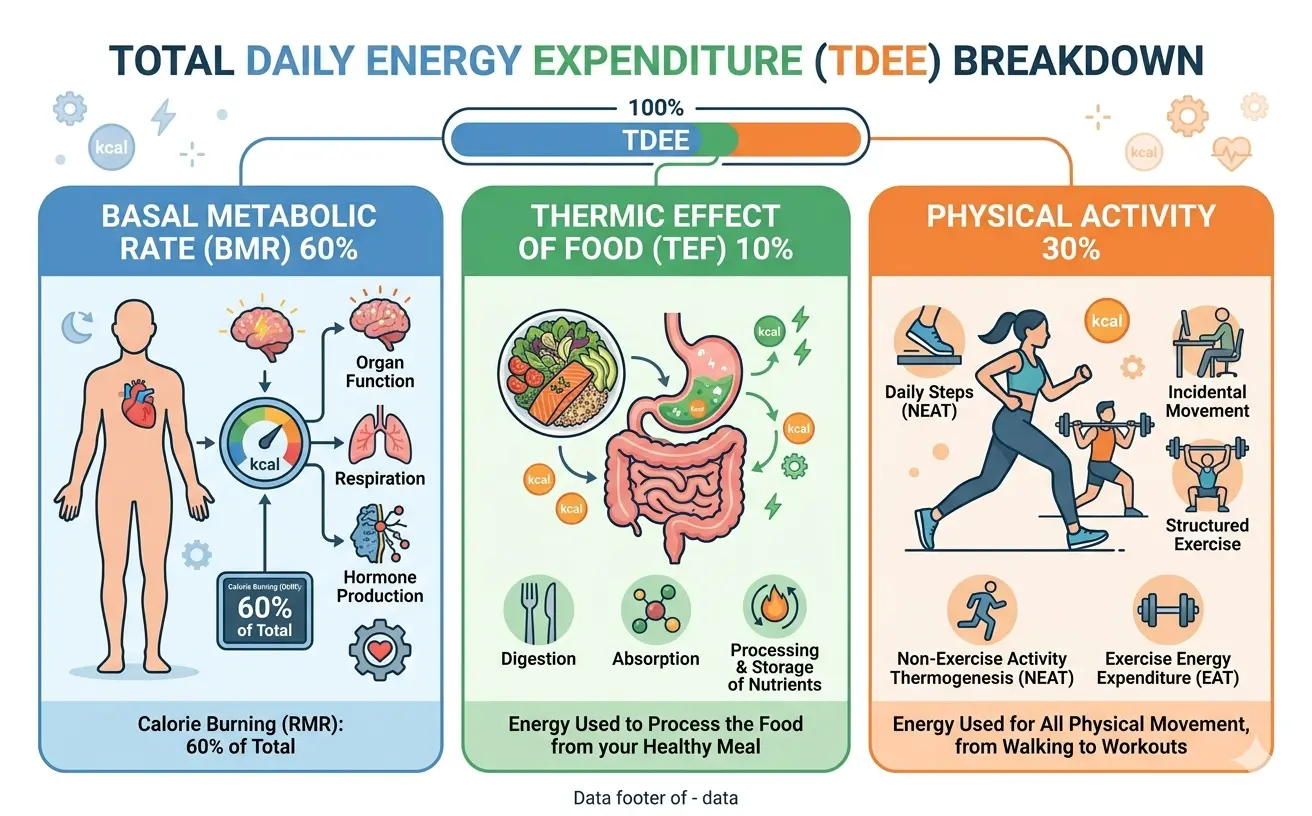
The Mifflin-St Jeor equation is a mathematical formula that estimates your Basal Metabolic Rate, or BMR. Your BMR is the number of calories your body burns at complete rest — the energy needed just to keep your heart beating, your lungs breathing, your brain functioning, and your cells repairing. It does not include any calories burned through walking, exercising, or even digesting food. It is the absolute baseline.
The equation was developed in 1990 by researchers Mifflin, St Jeor, and their team at the University of Nevada School of Medicine. Their goal was to create a more accurate BMR formula for modern populations, since the widely used Harris-Benedict equation from 1919 was based on a smaller, less diverse group of subjects from over a century ago.
The Actual Mifflin-St Jeor Formulas
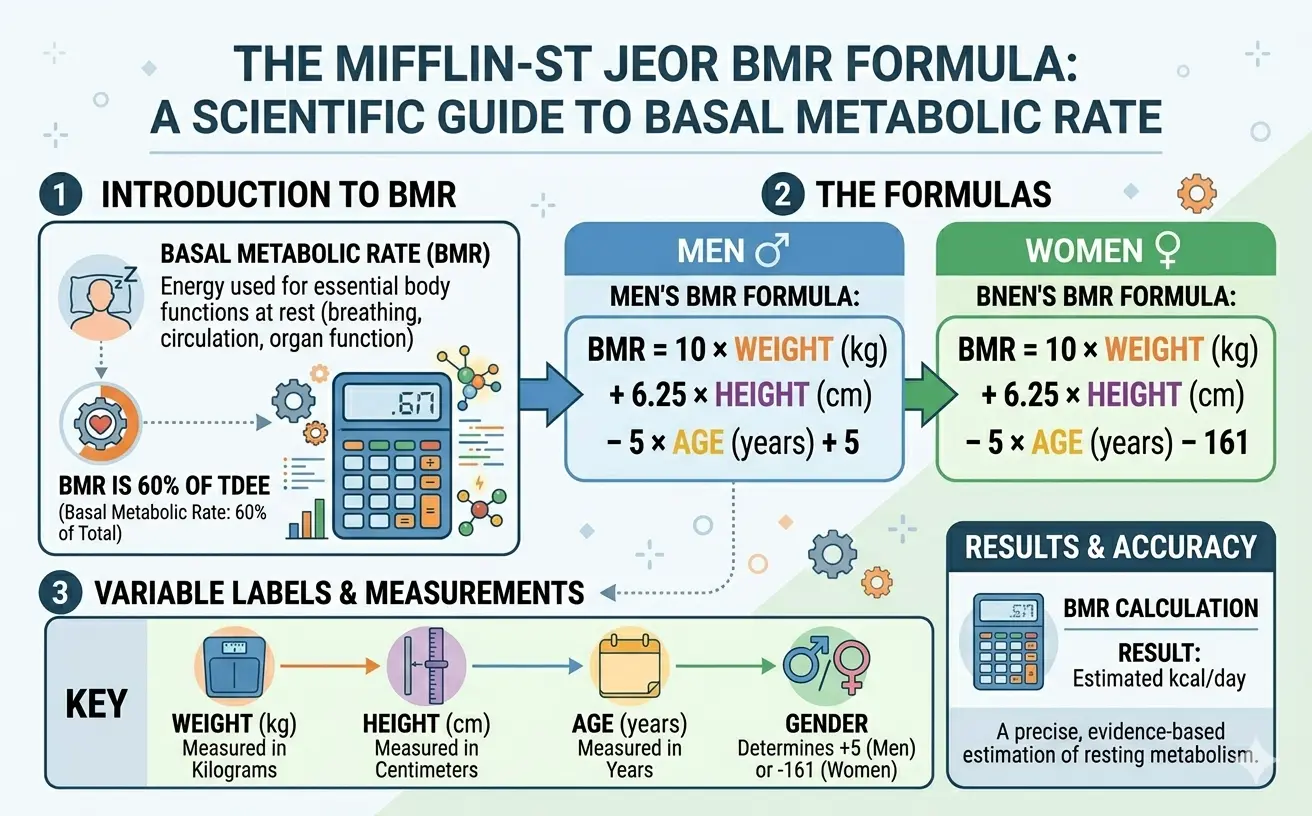
Here are the exact equations. There are two versions — one for men and one for women — because of physiological differences in average body composition between genders:
Notice that both formulas use the same coefficients for weight, height, and age. The only difference is the constant at the end: men add 5, women subtract 161. This reflects the fact that men, on average, carry more lean muscle mass than women of the same weight and height, and muscle tissue burns more calories at rest than fat tissue.
Example: Calculating BMR with Mifflin-St Jeor
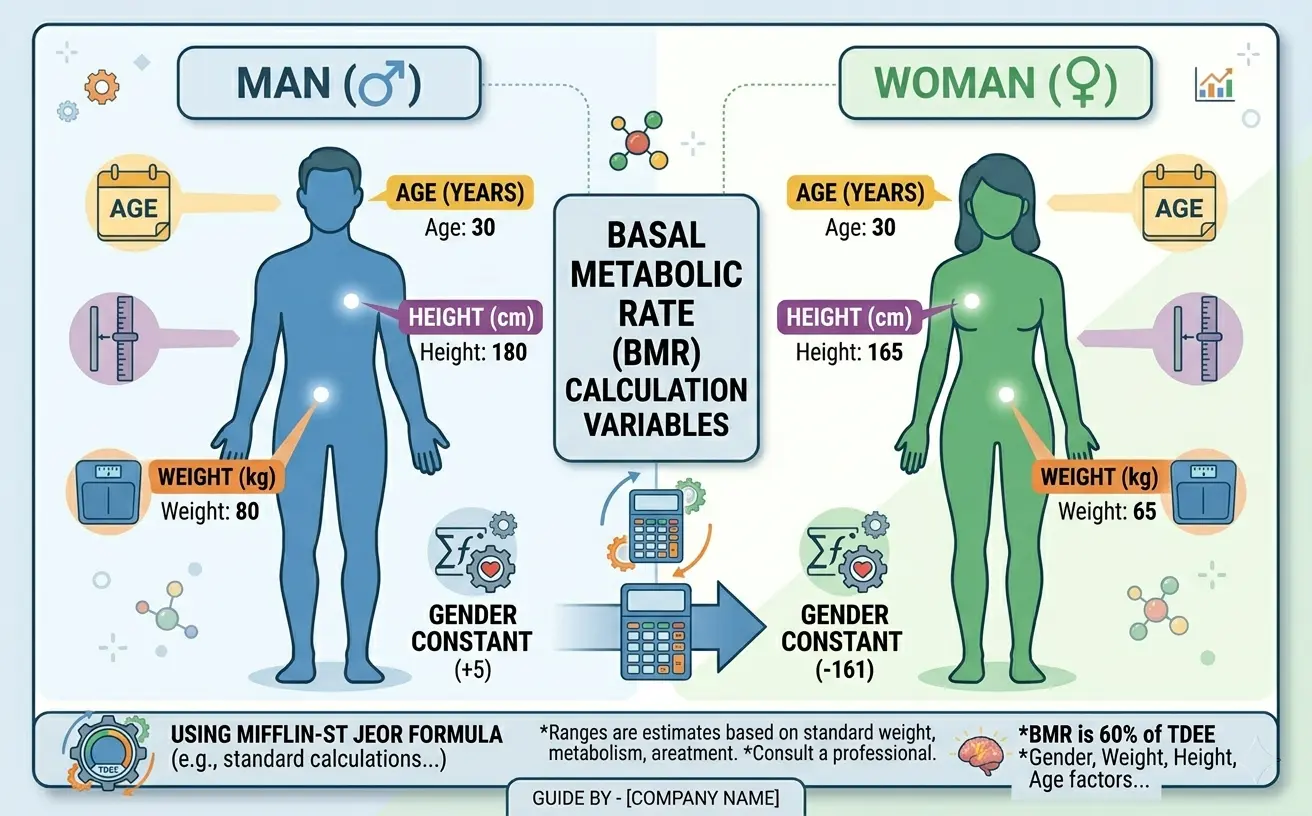
Let us walk through a real example. Consider a 35-year-old man who weighs 80 kg and stands 178 cm tall:
- Step 1: (10 × 80) = 800
- Step 2: (6.25 × 178) = 1,112.5
- Step 3: (5 × 35) = 175
- Step 4: 800 + 1,112.5 − 175 + 5 = 1,742.5 calories
This means his body burns approximately 1,743 calories per day at complete rest. To get his total daily calorie burn, or TDEE, this BMR is multiplied by an activity factor. If he is moderately active, that factor is 1.55, giving him a TDEE of roughly 2,700 calories per day.
Now consider a 30-year-old woman weighing 65 kg and standing 165 cm tall:
- Step 1: (10 × 65) = 650
- Step 2: (6.25 × 165) = 1,031.25
- Step 3: (5 × 30) = 150
- Step 4: 650 + 1,031.25 − 150 − 161 = 1,370.25 calories
You can get these exact calculations instantly using our calorie intake calculator without doing any math yourself.
Mifflin-St Jeor vs Harris-Benedict: Why the Switch Happened
Before Mifflin-St Jeor became the standard, most calorie calculators used the Harris-Benedict equation, first published in 1919. That formula had a good run, but research eventually showed it had a significant flaw: it overestimated BMR by 5 to 10 percent in modern populations.
Here is why Harris-Benedict became outdated:
- The original study population was too narrow: The 1919 research was based on a small group of predominantly young, white, normal-weight subjects. It did not represent the diversity of body types, ages, and ethnicities in the modern population.
- Body composition has changed over a century: People today are, on average, heavier and carry a different ratio of fat to muscle than people in 1919. A formula built on data from leaner populations will not be as accurate for today's bodies.
- Mifflin-St Jeor was validated on a larger, more diverse group: The 1990 study included 498 subjects ranging from normal weight to obese, across a wider age span. This made the resulting formula more generalizable.
For these reasons, the Academy of Nutrition and Dietetics and most clinical dietitians now recommend Mifflin-St Jeor as the preferred BMR equation for the general population. If you want to understand how BMR fits into the bigger picture of total daily energy expenditure, read our guide on TDEE activity level multipliers.
From BMR to TDEE: How Activity Multipliers Complete the Picture
Knowing your BMR is useful, but it is only half the story. Your BMR tells you what your body burns at rest. To get your total daily calorie burn, or TDEE, your BMR is multiplied by an activity factor:
- Sedentary (little or no exercise): BMR × 1.2
- Lightly active (light exercise 1-3 days/week): BMR × 1.375
- Moderately active (moderate exercise 3-5 days/week): BMR × 1.55
- Very active (hard exercise 6-7 days/week): BMR × 1.725
- Super active (physical job plus intense training): BMR × 1.9
These multipliers are what transform a theoretical BMR number into a practical daily calorie target you can actually use. For a deeper dive into choosing the right activity level, see our full guide on how to choose the right activity level.
How Accurate Is the Mifflin-St Jeor Equation?
No formula is perfect, but Mifflin-St Jeor is the best we have for the general population. Studies show it predicts BMR within approximately 10 percent of laboratory-measured values for most healthy adults. That means if the formula says your BMR is 1,500 calories, your true BMR as measured in a lab is likely somewhere between 1,350 and 1,650 calories.
Accuracy does vary for certain groups:
- Very muscular individuals: Muscle burns more calories than fat, so the formula may slightly underestimate BMR for bodybuilders and strength athletes.
- Pregnant or breastfeeding women: The formula does not account for the increased metabolic demands of pregnancy or lactation.
- People with certain medical conditions: Thyroid disorders, metabolic diseases, and some medications can significantly alter BMR in ways the formula cannot predict.
- Older adults with significant muscle loss: The formula may overestimate BMR for elderly individuals who have lost substantial muscle mass.
Despite these limitations, Mifflin-St Jeor remains the recommended starting point for calculating calorie needs. Treat your result as an estimate, then adjust based on real-world results over several weeks. For a complete beginner's overview, start with our guide on how many calories should I eat a day.
Why Knowing Your BMR Matters
You might wonder why any of this math matters when you can just plug numbers into a calculator and get an answer. Understanding your BMR helps you in several practical ways:
- It explains why calorie needs change with weight: A 200-pound person has a higher BMR than a 150-pound person. As you lose weight, your BMR drops, and your calorie target needs to drop with it. This is why weight loss plateaus happen.
- It shows why muscle matters: Since the formula multiplies weight by a constant, and muscle is denser than fat, two people of the same weight can have different actual BMRs depending on body composition.
- It clarifies why men often need more calories: The +5 versus −161 constant in the formulas reflects biological differences in average muscle mass, not a random distinction.
- It explains age-related weight gain: The formula subtracts age, meaning a 50-year-old has a lower BMR than a 25-year-old of the same weight and height. This is why many people gain weight as they age even without changing their diet.
Frequently Asked Questions
Is Mifflin-St Jeor better than Harris-Benedict?
Yes, for most people. Multiple studies have shown that Mifflin-St Jeor predicts BMR more accurately than Harris-Benedict in modern populations, particularly for people who are overweight or obese. Harris-Benedict tends to overestimate BMR by 5-10%, which can lead to eating more calories than intended. Most dietitians and health organizations now recommend Mifflin-St Jeor as the preferred formula.
Why are there two different formulas for men and women?
Men and women have different average body compositions. At the same weight and height, men typically carry more lean muscle mass and less body fat than women. Since muscle burns more calories at rest than fat, the formulas use different constants (+5 for men, −161 for women) to account for this physiological difference.
Can I calculate my BMR manually without a calculator?
Yes. Take your weight in kilograms, multiply by 10. Take your height in centimeters, multiply by 6.25. Take your age, multiply by 5. Add the first two results together, subtract the third, then add 5 if you are male or subtract 161 if you are female. That is your estimated BMR. However, using an online calculator is faster and eliminates arithmetic errors.
Does the Mifflin-St Jeor equation work for athletes?
It provides a reasonable estimate, but it may underestimate BMR for very muscular athletes. The formula is based on total body weight and does not distinguish between muscle and fat. If you are a strength athlete or bodybuilder with above-average muscle mass, your actual BMR may be 5-10% higher than the formula predicts. Adjust your intake based on real-world results.
What is the difference between BMR and RMR?
BMR, or Basal Metabolic Rate, is measured under strict laboratory conditions: after 8 hours of sleep, 12 hours of fasting, in a completely rested state. RMR, or Resting Metabolic Rate, is measured under less strict conditions and is typically about 10% higher than BMR. In everyday conversation and in most online calculators, the terms are often used interchangeably, and the Mifflin-St Jeor equation estimates BMR.
Related Guides: Understand the Science Behind Your Calories
Take your knowledge further with these in-depth resources:
- Daily Calorie Calculator: How to Calculate Your Needs — A step-by-step walkthrough of BMR and TDEE.
- Activity Level Multipliers Explained — How to choose the right TDEE factor for accurate results.
- How to Calculate Calorie Intake for Muscle Gain — Apply BMR knowledge to building muscle.
- Calories Per Day to Lose Weight: Safe Deficit Guide — How to use your TDEE for weight loss.
Try the Mifflin-St Jeor Equation Yourself
You do not need to do the math by hand. Our free calorie intake calculator runs the Mifflin-St Jeor equation automatically. Enter your weight, height, age, and gender, and get your BMR and TDEE in seconds. No sign-up, no cost, instant results. It is the fastest way to turn this formula into a number you can actually use.